The Mystery of the "Mystery Ship" #3
Last Updated: Wednesday, 12 August 2015 04:28 Nick Spark Hits: 932
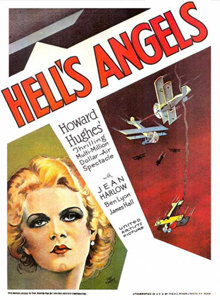 Pancho's Mystery Ship not only helped her achieve a place in the record books, but it opened the door to a new and exciting world — motion picture stunt flying. In 1926 Howard Hughes began pre-production work on a film about aviation combat in WWI. The making of "Hell's Angels" remains a Hollywood legend, one most recently celebrated in the film "The Aviator" starring Leonardo DiCaprio as Hughes.
Hughes' film would be one of the most expensive made to that date, a whopping $3.8 million. A WWI style aerodrome was built near the Van Nuys Airport, and nearly fifty vintage aircraft assembled for the production. Frank Clarke served as lead pilot, and many other notable fliers were involved including Ira Reed and Roscoe Turner whose Sikorski S-29 was flown as a mock Gotha bomber.
By 1928 the film was almost complete, but by then the world's first sound film "The Jazz Singer", had made its debut. Rather than release "Hells Angels" as a silent film, Hughes determined to reshoot portions of the film with dialogue and dub in sound effects. This is where Pancho came in! Her Mystery Ship was well known not only for its looks, but for its powerful motor, which was capable of producing a throaty roar in flight. Thus, through her friendship with Frank Clarke and because of her Model R, Pancho found herself hired to produce sound effects for Hughes' film.
The set-up for the sound recording was simple. A microphone was attached to a balloon set up above Hughes' aerodrome, known as Caddo Field. Pancho flew at the balloon from a variety of angles, and stunted above and below the balloon, as all the while sound technicians recorded her plane's motor. The result: enough material to create a sound effects library for the movie.
Many people believe Pancho flew as a stunt pilot in "Hells Angels", but as you have just learned, that's not really the case. Nevertheless, when you watch the film, you are hearing Pancho flying!