
Saturday, October 24, 2026

Last Updated: Wednesday, 12 August 2015 04:31 07 February 2008 Nick Spark Hits: 4511
After Pancho Barnes' ranch burned to the ground, and a long and much-publicized legal battle over seizure of her property (which we'll get into in a future Production Journal), Pancho disappeared from public view. Although as a result of the legal proceedings, she was banned from visiting Edwards Air Force Base, she continued to live nearby. Her first home was in Jawbone with her husband Mac. Later, after she and Mac divorced, she lived in Cantil and finally Boron. It wasn't until the mid-1960s, a decade after Pancho's legal battles with the Air Force, that she was "rediscovered" by a flight test engineer named Ted Tate (see 1-02-07 Production Journal). Tate helped broker a rapprochement with the Air Force, and brought some joy back into Pancho's life, re-introducing her to many of her friends at the base.
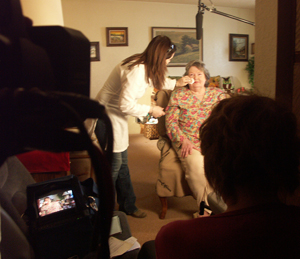 One of the new friends Pancho made at that time, was Barbara Rowland (pictured at right, getting her make-up adjusted during our interview), who was the secretary of the commander of Edwards Air Force Base. "When [Pancho] first walked into the office," Rowland related, "I had to ask somebody as she went by, 'is that a man or a woman?' And he said, 'Oh, that's Pancho Barnes!' And so I said, 'Is that a man or a woman?' With a name like Pancho! So he said, 'It's a woman. She's a flier.' So, she visited with the General for a while, and then came out and stopped at my desk and said, 'Hiya! The General told me if I needed help to go anywhere on the base, you would help me get there. So I took her in my car, and we drove around the base."
The two ended up becoming great friends, which was good for Rowland's psyche. Her husband had recently been killed in an accident, and she was depressed and having a tough time raising her children alone.. "I was still very much mourning the loss of my husband," Rowland remembers. "And I don't know if it was her idea of the General's, but she kind of took me over. She said was being wasted, and that I should be enjoying life. And so she sort of helped me do that, in a big way." Pancho forced Rowland to mix with society again. "Once we went down to Los Angeles together, to meet with some of her friends at the Tallmantz Air Museum -- with Frank Tallman and Paul Mantz, who were friends of hers. After that, I felt like, this is something I would like to do again. Because everybody was just so jolly and laughing. So from then on, any time she wanted to go, I would take her, and I would invite her to things. It was particularly fun, when she and (General Jimmy) Doolittle were together, because they went back a long way."
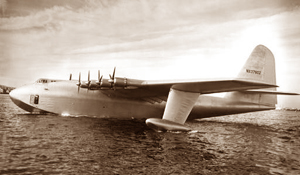 One of the more interesting trips Barbara remembers, was a drive down to Long Beach. At that time, Pancho was trying to get some airplanes donated to the new Aero Museum at Fox Field in Lancaster. "We drove down to Newport Beach, and I look around and there's all these men in dark suits and like, I am a little leery. And this man came out of the shadows. Very tall, skinny, gaunt-looking man who looked at me. And [Pancho and the man] carried on this conversation. Then we went inside this hangar and, I couldn't believe it! There was this huge plane, and they were talking about it and talking about it." The plane? The Spruce Goose. The man? Howard Hughes! "Pancho told me that they had been bitter enemies," Barbara notes with a laugh. "But, something must have turned around, because this was very cordial."
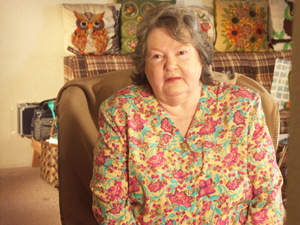 Pancho became a fixture at Barbara's house, and got along terrifically with Barb's mother. "My mother was a Southern lady," she says. "Who crocheted, and did all this lady stuff. She and Pancho would just sit there, and talk and talk and talk! My mother says to me, 'You know, Pancho thinks she is her own mother's biggest disappointment, because she's not a lacy, lady-like thing.' You know, [her mother] raised her to be a lady. But it didn't take!"
One of Barbara's favorite memories of Pancho, was when a special event was held on the base. She put the elderly aviatrix on the guest list. "I know you're supposed to introduce the General to her, but I introduced her to the General," Rowland remembers. "And she held up her glass and said something in Spanish. And he smiled at her and said, 'Thank you. And what does that mean?' And she said, 'F-you jack!' Only, she said it! Well, he just looked at her and laughed, because I am sure he had heard the stories." Asked about Pancho's passing, Rowland is quiet and somber. "I really felt her loss," she notes. "There was only one Pancho, and I'm very grateful I knew her. She really did enjoy life, and wanted everybody else to enjoy it. And she helped me learn how, again. She taught me how to live again."
Last Updated: Wednesday, 12 August 2015 04:31 06 February 2008 Nick Spark Hits: 4381
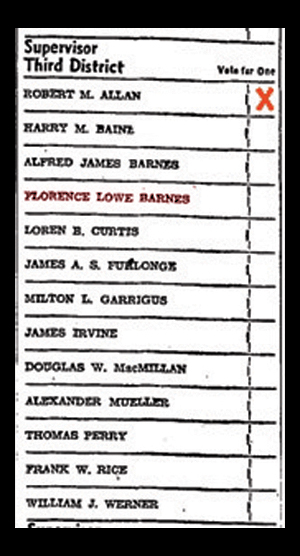 What with all the excitement surrounding the 2008 Presidential Election, it seems a fitting time to mention Pancho's career in politics. No Hillary, Pancho didn't run for President, but she did become the first woman to ever run for L.A. County Supervisor, back in 1932.
It all came to pass when Supervisor J.D. Mahaffrey died in office. Pancho, a wealthy heiress from a politically connected family, sensed an opportunity. And why not get into politics? She had helped organize the motion picture stunt pilots union and the Women's Air Corps in recent years, and out of all the Los Angeles women involved in aviation, she had the strongest name recognition. She'd broken Amelia Earhart's air speed record the previous year, and been honored by California Governor Rolph. Her photo appeared on the front page of the Times as a result. Plus, her feats in the air and elsewhere were often mentioned in the society page column, written by Alma Whitaker.
Notably, both Whitaker and the Times reporters referred to Pancho as "the wife of the Reverend C. Rankin Barnes" and mentioned the family's connections to charity and social service. So, despite Pancho's wildness and the fact that she was a hell-raiser in all sorts of ways, her public persona in many ways appeared to be a tame one. As Lauren Kessler explained to us, "No one could talk too ill of [Pancho], because she was a married woman. So she was able to be wilder, married to a minister, than if she had been a single woman at the beginning of the flapper age."
Image at above right: The official ballot as it appeared in 1932, in the L.A. Times, which endorsed L.A. City Councilman Robert Allan for the position. (The red color is added).
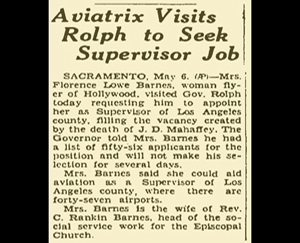 Pancho's first political move was not to run for office, but to ask Governor Rolph to appoint her to the vacant seat. According to the Times, she told Rolph that she was uniquely qualified in that "she could aid aviation as a Supervisor in Los Angeles County, where there are forty-seven airports". The Governor was not swayed, but by now Pancho felt invested in the notion of being Supervisor. She started to campaign, against what eventually emerged as a field of eleven men.
Pancho's campaign style was, like everything in her life, unorthodox. Supposedly she flew over the city and wrote her name in the sky, in hopes of attracting votes! She also did some of the standard things, like addressing members of the L.A. City Women's Club. She apparently even showed up for the meeting in a skirt, in an attempt to woo their support. "Pancho hasn't cultivated the society of women much, outside of lady aviators," Alma Whitaker noted dryly. "She insists sex should make no difference, but couldn't resist saying women should support her as the 'first woman supervisor'". I don't know what Pancho's campaign platform was, or whether she ever got a chance to debate her rivals. In the end, the Times ended up endorsing another candidate, and Pancho lost in a landslide. Still, it's undeniable she was a pioneer in politics, just like she was in the air. One has to wonder, if she had won, what her impact might have been on the political landscape?
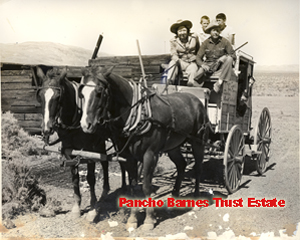 Despite the bruising loss, Pancho wasn't entirely through with politics. Three decades later in 1960, while living in the Mojave Desert, Pancho ran for constable of the Rand Judicial District. As part of her campaign (photo at right), she had her old stagecoach adorned with signs for the various towns in the district, and drove it in a parade. The stunt attracted attention, but few votes.
Last Updated: Wednesday, 12 August 2015 04:31 27 January 2008 Nick Spark Hits: 7188
 During Pancho's flying career in the late 1920's and early 30's, she made a lot of friends who were military pilots. Some of them would go on to do extremely important things in aviation. Jimmy Doolittle, who she met as a result of attending air races, pioneered instrument flying, and led the famous "Doolittle Raid" on Japan in 1942. Both Hap Arnold and Carl "Tooey" Spaatz, who Pancho met at March Field near Los Angeles, became commanding generals of the Air Force.
"The first thing I remember about [Pancho's] place," Brig. Gen. Bob Cardenas told us, "was behind the bar was a painting of her in boots and breeches. She had one arm around Second Lt. Tooey Spaatz, and the other arm around Second Lt Hap Arnold. That impressed the hell out of me, who the hell she really was - a pilot. And a damn good one."
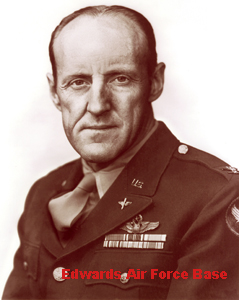
Another one of Pancho's good friends was Colonel Albert Boyd. Boyd had joined the Army Air Corps and earned his wings in 1927, right around the same time that Pancho did. He went on to have an extensive career as a test pilot — and I mean extensive. By the time Boyd retired in the late 1950's, he'd flown over seven hundred different types of fixed and rotor wing aircraft, and logged over 23,000 hours of flight time. If you're doing the math, that's over two and a half years in the air!
 After serving in the Air Service Command during WWII, Al Boyd was named chief of the Flight Test Division at Wright Field. Boyd was also in charge of test pilots and other personnel assigned to "temporary duty" at distant Muroc AFB (later Edwards AFB). Eventually, Boyd would become commander of Edwards, which explains how Boyd met Pancho.
"Colonel Boyd was chief of flight test division and he was a pilot’s pilot," Cardenas says. "And he was a no-nonsense guy. He never demanded of you anything that he wouldn’t do. He was very capable and of course extremely intelligent. Anyway, he and Pancho were kind of soul mates more or less. She loved him and he liked the hell out of her. Because of what she was - you know, a pilot. And down to earth, and common sense, no nonsense. Could outcuss any mule skinner out in the desert. So they were real friends."
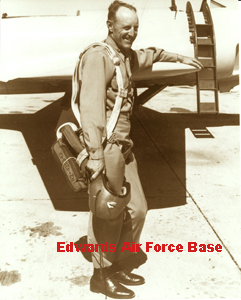
Photo: Col Albert Boyd stands beside a Lockheed P-80 Shooting Star. This was probably snapped in 1947, when he set a new official world airspeed record of 623.62 mph (1,003 km/h) in the aircraft.
Their closeness was in itself remarkable, since after all Boyd demanded the attention and respect of every one of his subordinates. He could inspire, but he could also put the fear of God into you. Chuck Yeager put it this way, "Colonel Boyd was a tremendous leader. Tough as nails. And man, I tell ya, he really was a good pilot. When Boyd came out as commander, he straightened the place up in short order. It was pretty loose out there, like, we did pretty well what we wanted to, you know because there was nobody looking over our shoulder, but when General Boyd came in, man, he straightened the place up in a hurry... General Boyd was a very close friend of Pancho’s," Yeager adds," and he liked her. But, she may mouth off to General Boyd, but she’d only do it one time. Because he’d tell her to shut up!"
 As head of the Flight Test Division, Al Boyd was in charge of the X-1 project, and the man who selected Chuck Yeager to make the flight. (In fact, it was Al Boyd who first recognized Yeager's potential as a test pilot, sending him to test pilot's school in January, 1945). The way Yeager remembers it, Boyd told him of his selection as primary X-1 pilot in a very few words, explaining that he felt the aircraft could get above Mach 1, and "don't screw up." What else could Yeager say but, "Yes, sir" in reply?
Bob Cardenas, who flew the B-29 mother ship for the X-1 project, also remembers Boyd choosing his words carefully. "His instructions to me," Cardenas notes, "were, 'Safety of flight is paramount, but it is not to impede success.' That was his instructions to me."
The X-1 tests were extremely dangerous, but they were also a success. After the team broke the sound barrier, they partied at Pancho's bar. (See 5.23.07 and 5.30.07 entries).
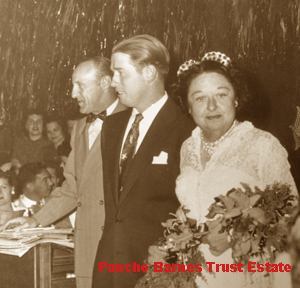
Photo (right, above): Al Boyd stands with Pancho and Mac on their wedding day. (Left, below): Pancho and Al Boyd are reunited shortly before her death. The woman on the right is actress and pilot Susan Oliver.
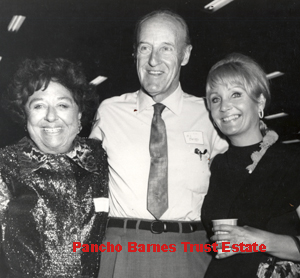 Al Boyd didn't make it to the celebration that day, but he did show up to another event — Pancho's wedding to Mac McKendry in 1953. To get to Pancho's, he flew cross-country in a B-47, setting a new speed record in the process! Boyd ended up giving Pancho away in the ceremony, a fitting tribute from one of her best friends.
By the time of Pancho's wedding, Al Boyd had been reassigned from Edwards back to Wright Field. His replacement, General Stanley Holtoner, was a former fighter pilot. But unlike Boyd, he would never be friends with Pancho. Instead, they became bitter enemies — but that's a subject for a future Production Journal.
Al Boyd retired from the Air Force in 1957, and passed away in 1976. By then, he'd been awarded the Distinguished Flying Cross, and become known as the "Father of Modern Flight Testing" and the "Dean of American Test Pilots".
Last Updated: Wednesday, 12 August 2015 04:31 22 January 2008 Nick Spark Hits: 4467
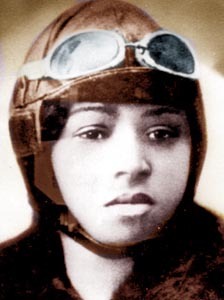 Today, Martin Luther King, Jr. Day, I found myself thinking about Bessie Coleman (1892-1926). She wasn't just the first African American woman to fly, but the first American woman to hold an international pilot's license period. Her story may be the most improbable of all the aviation pioneers. She was the daughter of a sharecropper, and one of thirteen children. The chances of her ever getting into a plane, even as a passenger, were incredibly remote. Yet in 1920, supposedly while working as a manicurist, Coleman became infatuated with the idea of becoming a pilot. Damned if she didn't manage to persuade some folks to back her in the undertaking! When it became clear no one in the USA would train a black woman to fly a plane, Coleman enrolled in a Berlitz class in French, and then traveled to Paris where she learned to fly a Nieuport Type 82 biplane.
When she returned to the United States, she decided to try and make a go of it, performing in air shows. She quickly became a celebrity, and not just for her sex or the color of her skin, but her pluck, beauty, and daring. Known as "Queen Bess", Coleman seemed undaunted by danger, and her spirit never wavered despite several bad accidents. During a show in Los Angeles in 1922, her plane stalled and spun in, and Coleman shattered her leg and cracked three ribs. Yet, as soon as she recovered, she was back in the air.
Coleman might have had a long career and become more famous than Earhart, but sadly her luck ran out. In 1926, while flying in Jacksonville, Florida, she and her mechanic were killed when her plane went into a nosedive. She was only 34 years old. It was a sad end to an amazing story, one that truly was all about doing what you want to do, for the sake of doing it, and letting no one stand in your way. (From that standpoint, Pancho Barnes would certainly have approved!)
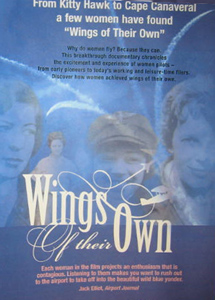 Recently, I watched a film that features not just Bessie Coleman, but dozens and dozens of female pilots. "Wings of Their Own" was directed by Mary Scott and produced by Abby Dress, and came out recently on DVD. You can visit the website at this link. (When visiting, make sure to click on the button on the valentine that appears on the right side of the screen, so you can read bios of the women who participated in the film).
"Wings of Their Own" presents the history of women in aviation, and explains the allure of the skies in terms anyone can appreciate. What's remarkable about the movie, though, is the attitude it takes -- encouraging any woman who might be considering learning to fly, to get out there and do it. That's one of the reasons this film would make an excellent gift to give to your daughter, or any young woman you know who has ever dreamed of learning to fly.
The Airport Journal put it this way, "Each woman in the film projects an enthusiasm that is contagious. Listening to them makes you want to rush out...and take off into the beautiful wild blue yonder." That's just about what I'd say, too!
Speaking of other documentary films, Circus Rosaire, a documentary shot by one of our cinematographers Chad Wilson, and directed by his wife Robyn Bliley, is screening at Slamdance this week! What's more, the film was edited by our own expert cutter, Monique Zavistovski. The film, which is about a family run circus, got a wonderful review in Variety. You can read about the film at the official website, here.
Last Updated: Wednesday, 12 August 2015 04:31 16 January 2008 Nick Spark Hits: 5151
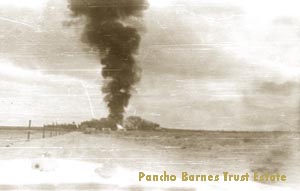 Although we didn't think to do it, we probably should have had a moment of silence in the cutting room on November 14th. (Moments of silence when you're editing, and debating how to edit, are rare moments indeed!) But the reason for a bit of solemnity on that day, is that it was on November 14, 1953 that a fire destroyed part of the Happy Bottom Riding Club. Despite the desperate efforts of firemen from Mojave, Tehachapi, and Edwards Air Force Base, the inferno consumed the ranch's large dancehall, and Pancho's home. Pancho explained to the press, in the wake of the fire, that she and her husband had lost all of their personal property, including clothes and Pancho's jewelry, fur coats, paintings, art work, and memorabilia -- including many of her aviation awards.
Photo (above): a view of Pancho's ranch on fire, snapped by an unknown friend.
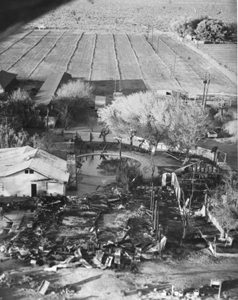 Pancho and her husband Mac weren't home at the time of the fire, but arrived as the embers were being extinguished. They'd apparently seen the tower of smoke on the horizon, and initially thought what everyone in those parts thought in those days, when they saw such a thing — a plane from Edwards must have crashed.
Thankfully, no one was killed or injured in the blaze. But the damage to the ranch, estimated to be in the $300,000 range, would signal an end to the "happy days" at the "Happy Bottom".
Photo (left): The remains of Pancho's house, and the dance hall, still smolder after the fire. The circular swimming pool, visible in the photo, was supposedly drained a couple of days before the fire for maintenance.
From the start, the fire seemed suspicious. Jack Leird, the ranch foreman, told a reporter that the blaze started in the dance hall "with a puff of smoke" followed by a loud explosion. Other witnesses stated that the explosion had so much force, it blew out one end of the dance hall. Pancho was convinced the blaze was arson -- perhaps even a bomb.
That explanation made sense, for a couple of reasons. A few years before, Pancho's stables had been torched in a blaze that was determined to be deliberately set. That fire, while devastating, was contained fairly quickly. Nevertheless, Pancho's prized stallions were burned to death. Although there was an individual believed responsible, no one was ever charged, and Pancho never knew the reason for the crime. Was somebody simply getting a thrill, or was someone settling a score?
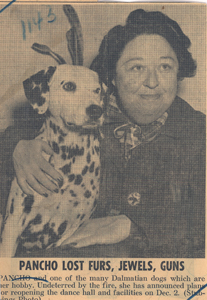 In the case of the 1953 fire, Pancho didn't have to look hard to find a person who, she believed, might be responsible. The prime suspect, in Pancho's eyes? An officer in the United States Air Force. Specifically, Pancho told friends that she believed General Stanley Holtoner, the commander of Edwards AFB, was involved. The charges seem incredible to anyone who wasn't there at the time... How could Pancho, the self-described "Mother of the U.S. Air Force" actually believe that one of its finest was out to get her?
Actually, Pancho was not acting crazy, and although some would say she was overly paranoid, she had her reasons to be that way!
Flash back to 1952, when the Air Force announced plans to expand Edwards, and indicated that they would condemn Pancho's property and that of her neighbors as part of the project. While her nearby rancher neighbors sold out their properties for what the government offered, Pancho chose to fight the seizure of her property, arguing that the Air Force wasn't offering her proper compensation.
Photo (above right): Pancho shown immediately after the fire with one of her prized Dalmatian dogs. Photo (below left): the papers featured extensive coverage of the devastating fire.
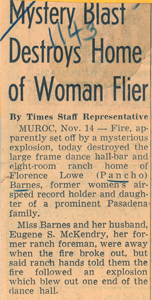 During the squabble surrounding her property, Pancho had a falling out with General Holtoner. (Actually, they never really got along from day one...a topic we'll cover in a future production journal). The result of the animosity between the two of them, was that Pancho's place was put off limits to personnel at Edwards.
Supposedly, during one of their "discussions" -- more likely arguments -- in April of 1952, Holtoner told Pancho he could arrange to have her ranch "napalm bombed off the desert". It was a remark he'd come to regret. When Pancho brought up the threat in court, the judge took it seriously, and the Los Angeles paper ran a story about it. A small article even appeared in the New York Times with the headline, "Threats to Bomb Ranch Charged to Air General."
So, roughly six months later, when an explosion and fire racked the dance hall, it was only natural that Pancho would believe Holtoner was responsible. Yet, the fire marshal couldn't find any evidence that Holtoner was involved, and refused to determine a cause for the blaze due to lack of evidence. So...perhaps the fire was arson...or perhaps it had some other cause.
"There have been a lot of accusations over the years about that fire," Edwards historian Raymond Puffer explained to us during an interview for the film. "[Pancho] was in the way of the base expansion. She did not particularly care for the commander, let us say. And right at that exquisitely sensitive moment, was the fire that destroyed the Happy Bottom Riding Club... So it was a very sordid matter. But officially we don't know. Officially, the fire's origin has never been judged."
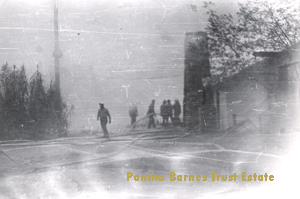 One fact described by Pancho about the fire did turn out to be either untrue, or at least slightly exaggerated. In the wake of the fire, she told many people that she'd lost all her personal memorabilia in the blaze, including all her photos and scrapbooks. While a tremendous number of precious items were destroyed, many things did survive the fire.
From what we've heard, some of the people who were at the scene apparently dashed into Pancho's burning house, risking their lives to save whatever they could. They managed to retrieve many of the photos, negatives and scrapbook-bound articles that appear on this website.
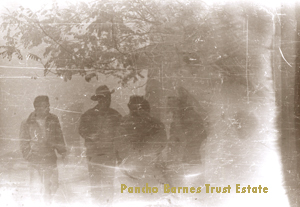 Some of the photos in the collection of the Pancho Barnes Trust Estate have burned edges and water damage, a lasting reminder of that fateful day that signaled the end, of the glory days at the Happy Bottom Riding Club.
Photo (left): The silhouettes of Pancho and her husband Mac are visible in this image, taken as the fire was extinguished. November 14, 1953 was probably one of the worst days of Pancho's extraordinary life.
Last Updated: Wednesday, 12 August 2015 04:31 26 December 2007 Nick Spark Hits: 4453
Well, it's time we say goodbye to 2007 and hello to 2008! But before the year goes into the slipstream, it's not a bad idea to look back... We've made terrific progress this year, wrapping production on interviews for the film, and beginning the editorial process. On Christmas Eve, a small group of us watched an 80-minute long "rough cut" of the film. The verdict? We've got a movie on our hands! Of course, we knew that was the case, but it's always gratifying to see something when it truly comes together for the first time.
 2008 should be a big year for "Pancho Barnes!", as we move to finish the cut, cast a narrator (someone has to do the voice of Pancho!), and do our sound mix. It will be a while in the making -- after all, we need to chop about 25 minutes from our rough cut so that it can be aired -- but we're making rapid progress. Stay tuned to the Production Journal for updates as they happen.
There are many, many thank yous that go out to so many people, that it's hard to organize a list. Our crew worked so hard on making our movie a reality...and that includes cinematographers Clay Westervelt, Chad Wilson and Harris Done, sound man Stu Sperling, make-up artist Christina Fabiani, our ace assistant Pam Dotson, graphics experts Jin Yee and Jeff Dietrich, and many others. Monique Zavistovski has worked tirelessly in the editing room, assisted by Tiffany Scherban. From Amanda Pope and I, thank you to one and all...
We look forward to meeting many of our loyal readers and supporters in 2008, when "Pancho" gets airborne. Thanks to you all for your interest in our project and your financial and moral support!
Your tax-deductible donation can help make "The Legend of Pancho Barnes!" a reality.


 O-Sense